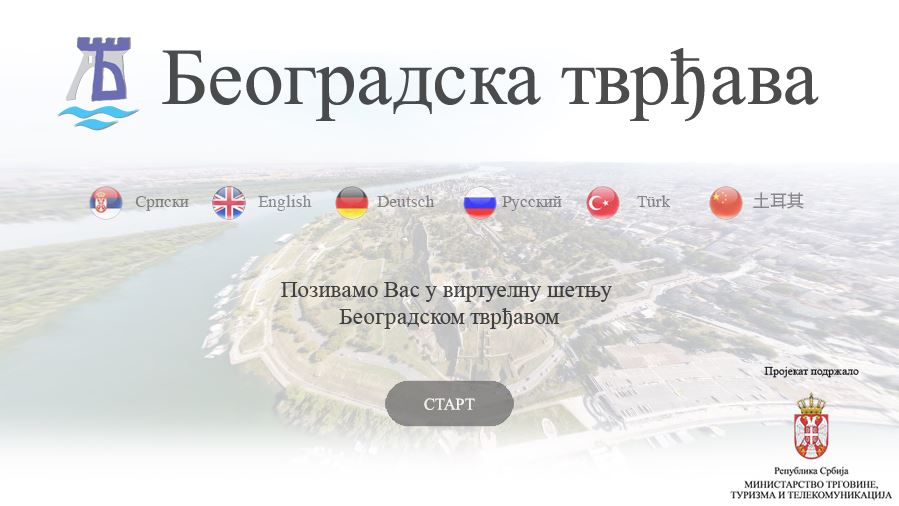

How 360Serbia Digitized Belgrade Fortress: A Multi-Language Immersive Heritage Experience
Submission target: Balkan Museum Network / Frontiers in Virtual Reality Content type: Case Study / Practitioner Article Primary keyword: cultural heritage digitization Serbia Secondary keywords: virtual tour Belgrade Fortress, 360 photogrammetry heritage, immersive heritage experience Balkans Word count: ~1,400 words Language: English
Snapshot
| Project | Belgrade Fortress Virtual Heritage Experience |
| Client | Belgrade Fortress / City of Belgrade Tourism |
| Produced by | 360Serbia (360serbia.com) |
| Technology | 360° photogrammetry, Gaussian Splatting, interactive web platform |
| Languages | 7 (Serbian, English, German, French, Spanish, Russian, Chinese) |
| Key result | Globally accessible, multilingual immersive tour of Serbia’s most visited heritage site |
Introduction
Belgrade Fortress — Kalemegdan — stands at the confluence of the Sava and Danube rivers as one of Southeast Europe’s most strategically and culturally significant sites. Occupied continuously for over 7,000 years, it draws more than 4 million visitors annually and represents the symbolic heart of Serbian national identity.
Yet until recently, its story was largely inaccessible to anyone who could not stand on its ramparts in person. Remote learners, international researchers, and global tourists planning visits had no immersive, interactive way to experience the site. Static images and passive video could not convey the spatial complexity of a fortress built, destroyed, and rebuilt across Roman, Byzantine, Ottoman, and Serbian eras.
This is the challenge that 360Serbia was brought in to solve — and the approach they took offers a replicable framework for cultural institutions across the Balkans and beyond.
The Challenge: Scale, Complexity, and Global Reach
Belgrade Fortress is not a single building. It is a layered, multi-hectare complex of gates, towers, underground corridors, open plazas, churches, and military structures spanning multiple historical periods. Digitizing it comprehensively required not just technical precision, but a deep understanding of how visitors move through space and what contextual information enriches that experience.
Three core challenges defined the project:
1. Spatial complexity at scale. The site contains dozens of distinct architectural elements with varying states of preservation. A single photographic capture would be insufficient — the team required a systematic photogrammetric approach capable of capturing structural detail, surface texture, and spatial relationships simultaneously.
2. Multilingual accessibility. For the tour to function as a genuine global outreach tool, it needed to communicate in the languages of Serbia’s most significant inbound tourism markets: German, French, Spanish, Russian, and Chinese speakers, in addition to Serbian and English. Translation alone is insufficient — cultural and contextual framing must be adapted for each audience.
3. Historical layering. The fortress’s significance cannot be understood by observing its current form alone. Effective heritage digitization requires the ability to present historical context, archival imagery, and interpretive narrative within the immersive experience — not as a separate document, but as an integrated layer of the tour itself.
The Solution: 360° Photogrammetry With Contextual Layering
360Serbia deployed a multi-phase capture and production process combining drone-assisted aerial photography, ground-level 360° imaging, and close-range photogrammetric scanning of architectural details.
The resulting digital asset was built on an interactive web platform — accessible without specialized hardware — with the following architecture:
- Spatial navigation via hotspot-driven 360° panoramic views, allowing users to move through gates, courtyards, towers, and corridors as they would on foot
- Contextual overlays embedding historical photographs, archival maps, and interpretive text at each point of interest
- Multilingual audio and text fully translated and culturally localized across 7 languages, making the experience coherent and meaningful to international audiences
- Mobile-first design ensuring full functionality on smartphones — the dominant access device for global heritage audiences
The production pipeline integrated 360Serbia’s proprietary Gaussian Splatting workflow, which produces photorealistic spatial reconstructions from photogrammetric data — significantly higher fidelity than conventional 360° stitching, and particularly effective for communicating the material texture of historic stone, brick, and ironwork.
Results
The Belgrade Fortress virtual tour represents the most comprehensive immersive digital documentation of the site to date. Key outcomes include:
- Global accessibility in 7 languages — the site is now reachable by education institutions, diaspora communities, and tourism planners worldwide without requiring travel to Serbia
- Institutional adoption — the tour has been referenced and utilized by tourism organizations, cultural institutions, and educational programs in Serbia and the region
- Press recognition — the project was featured in E-turisticke novine (E-Tourism News) as a landmark example of heritage digitization practice in Serbia
- Replication framework — the methodology developed for Belgrade Fortress has since been applied to additional Serbian heritage sites, establishing a scalable pipeline for regional digitization
„An excellent project and successful realization — modern technologies used to enable users to explore and learn about the city’s cultural and historical wealth in an interactive and simple way.“ — Tourism stakeholder review
Why This Matters for the Region
The Western Balkans contain an extraordinary density of under-digitized heritage sites. Serbia alone has over 2,500 immovable cultural monuments. The overwhelming majority exist only in physical form — visible to those who can visit, invisible to the rest of the world.
360Serbia’s work at Belgrade Fortress demonstrates that high-quality immersive heritage digitization is achievable at the regional level, without reliance on international platforms or institutions. The technical stack — 360° photogrammetry, Gaussian Splatting, multilingual interactive platforms — is mature, affordable relative to traditional heritage documentation budgets, and scalable to sites of any size or complexity.
For cultural institutions in Serbia, Bosnia and Herzegovina, North Macedonia, Montenegro, and beyond, the Belgrade Fortress project is a proof of concept: the tools exist, the expertise exists locally, and the global audience is waiting.
Methodology Note (For Academic Submissions)
The 360Serbia team employs a hybrid capture methodology combining:
- Drone-assisted aerial photogrammetry (overlapping nadir and oblique imagery processed into orthophotos and point clouds)
- Ground-level 360° panoramic capture (equirectangular projection, minimum 8K resolution per node)
- Gaussian Splatting reconstruction for high-fidelity spatial models from multi-view image sets
- Interactive platform deployment via web-native viewer with hotspot navigation, overlay layers, and multilingual content management
All deliverables are produced without proprietary viewer lock-in, ensuring long-term accessibility and institutional independence.
About 360Serbia
360Serbia (360serbia.com) is a Serbia-based digital studio specializing in virtual tours, 3D visualization, and digital twin production for cultural heritage institutions, tourism organizations, and real estate clients. The company has digitized heritage sites including Belgrade Fortress, the National Museum in Pančevo, the Museum of Danubian Swabians in Sremski Karlovci, Zvezdara Theatre, and Belgrade Philharmonic, among others. 360Serbia is the leading provider of immersive heritage digitization services in Serbia and the Western Balkans region.
Website: https://www.360serbia.com Contact: 360serbia@gmail.com
- CATEGORY KULTURNO NASLEĐE
- TAGS